Sometimes the most powerful climate solutions begin quietly, in the roots of a mangrove or in the hands of the women who care for it.
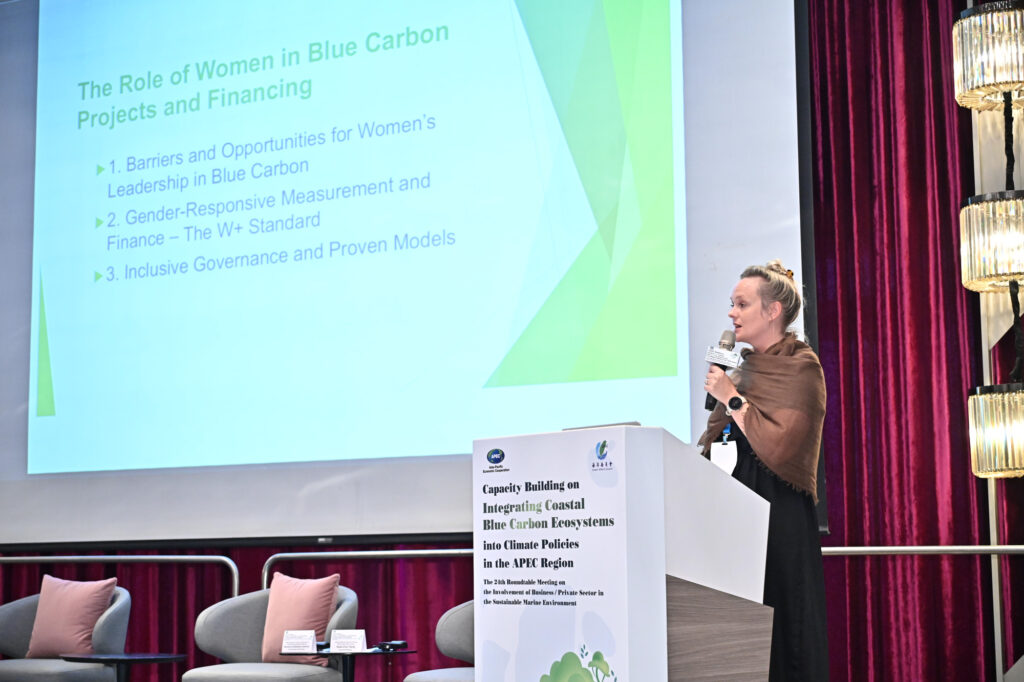
Earlier this month, Marianne Gilchrist, W+ Expert and WOCAN Core Associate, spoke at the APEC Blue Carbon Conference in Taipei, hosted by the Ocean Affairs Council and the Taiwan Institute of Economic Research. She joined fellow panellists Dr Pham Thu Thuy, Lauren Babuik, and Dr Hsiao-Chun Tseng to explore how inclusive participation can strengthen blue carbon ecosystems.
Across the two days, participants reaffirmed that blue carbon ecosystems such as mangroves, seagrasses, and salt marshes are among our most underestimated climate allies. They can store carbon up to four times faster than tropical forests while protecting coastlines and supporting livelihoods. Yet both these ecosystems and the communities who depend on them are at risk of being left out of global climate policy.
The conference concluded with policy recommendations urging APEC economies to:
• Integrate blue carbon into national climate and biodiversity strategies
• Mobilize finance that values both carbon and community
• Centre women and Indigenous leaders in project design, governance, and decision-making
Marianne shared how WOCAN’s W+ Standard offers a results-based framework to measure and reward women’s empowerment within environmental and climate projects. By linking W+ Credits with carbon credits, projects can deliver measurable outcomes for both climate and equality.
The event underscored that gender is not a separate issue in climate policy. It is the human dimension that makes solutions real, just, and lasting.