
The Gender Dividend: Outcomes-Based Finance at Goals House
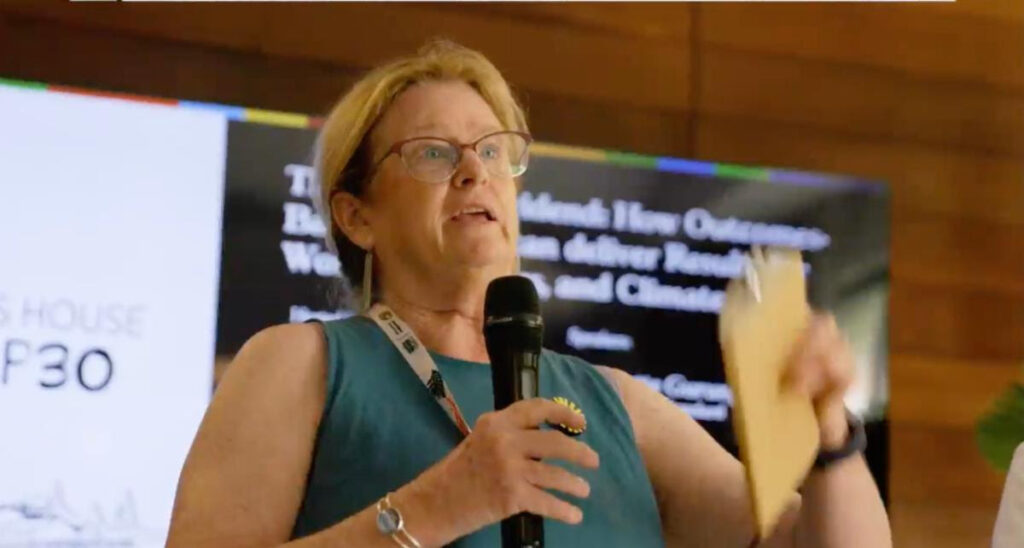
At Goals House, WOCAN helped open COP30 with a powerful conversation on how outcomes-based finance can transform climate action by delivering measurable results for women, investors, and the planet. The session, “The Gender Dividend: How Outcomes-Based Finance Can Deliver Results for Women, Investors, and Climate,” brought together global leaders, innovators, and change makers committed to linking climate finance directly to verified social and environmental outcomes.
Speakers included Jeannette Gurung (WOCAN), Claudia Press (SOMA), Bruna Rezende (IRIS), and Alexandra Leão (Natura).
This opening event set a collaborative and action-driven tone for COP30, reinforcing that gender-responsive, outcomes-based finance is essential to achieving meaningful, scalable climate solutions.
Harvesting Hope: Gender-Responsive Financing for Climate-Resilient Agriculture
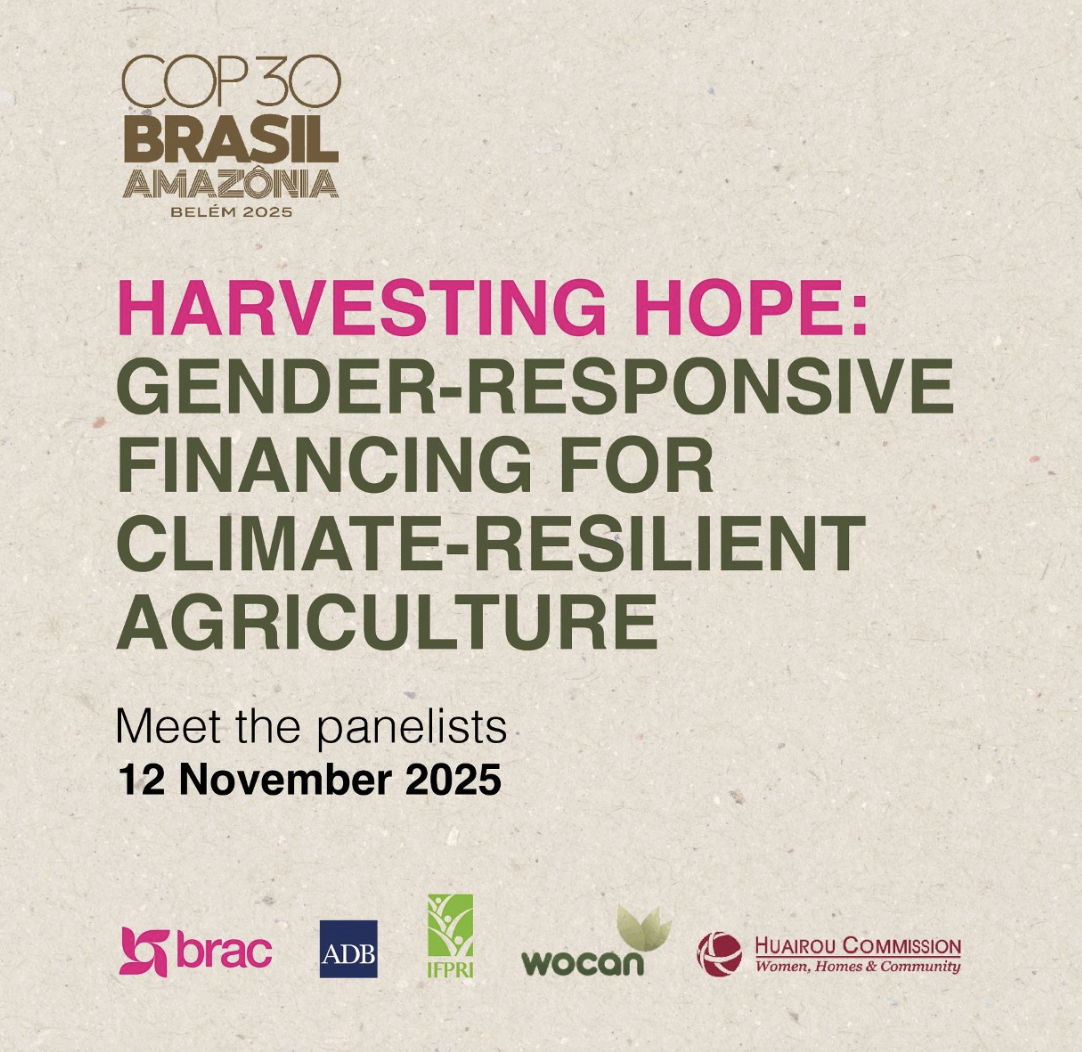
WOCAN held its UNFCCC Official Side Event with BRAC, ADB, and the Huairou Commission. “Harvesting Hope: Gender-Responsive Financing for Climate-Resilient Agriculture.” The session highlighted women smallholder farmers as both vulnerable frontline actors and powerful leaders in local food systems — while underscoring the urgent need to close the gender–climate finance gap.
Through a moderated dialogue, partners shared innovative approaches for directing climate finance to women and grassroots organizations. WOCAN presented how the W+ Standard and gender outcome credits can transform carbon and nature-based projects into new revenue streams for women’s groups, offering a measurable and scalable pathway for adaptation finance.
Contributions from BRAC (Building Resources Across Communities), the Huairou Commission, and the Asian Development Bank (ADB) showcased complementary models — from locally led climate services and community resilience funds to gender-responsive research frameworks and regional climate investment pipelines. Together, they advanced a unified vision: women farmers as central investors, innovators, and implementers of climate solutions, not peripheral beneficiaries.
Financing what works: Outcomes-based, gender-responsive investments for climate adaptation

At the Global Landscapes Forum’s 8th GLF Investment Case, WOCAN led a session highlighting how outcome-based, gender-responsive finance is transforming climate adaptation worldwide.
Speakers:Ana Maria Loboguerrero, (Gates Foundation)Bruna Rezende, (IRIS)Stéphane Van Haute, (Friendship, winner of the recent Earthshot Prize).
The panel emphasized that:Outcome-based financing delivers measurable, verifiable results, strengthening accountability and ensuring real impact for both communities and ecosystems.Women’s empowerment is a fundamental driver of adaptation, and must be financed as a core outcome rather than an add-on. Bruna Rezende highlighted that the W+ Standard offers a rigorous framework for verifying women’s empowerment outcomes and directing finance where it generates the greatest impact—while providing investors with a credible pathway to achieve social returns.Stéphane Van Haute noted that in effective, community-led adaptation models, carbon is the hook—a compelling way to showcase impact—rather than the main objective. He stressed that when carbon credits are sold, most of the financial benefits should flow directly to the communities who deliver the climate impact, and that in less than five years, these models can generate direct, tangible returns for local people.
The session made one message unmistakably clear: Financing what truly works means investing in models that reward verified impact—creating lasting benefits for women, communities and the planet.
Watch the session here
Beyond Carbon: Empowering Women, Financing Climate Adaptation
A shift is underway in the climate finance landscape: carbon projects are no longer just reducing emissions—they are also delivering verified, measurable benefits for women.

Day 9 at COP30 highlighted pioneering initiatives in India, from solar water pumps to mangrove restoration projects, that use the W+ Standard to quantify women’s empowerment across time savings, knowledge, and income alongside carbon reductions.
A session with the Global Carbon Council moderator Sandeep Roy Choudhury (Value Network Ventures) led a candid and insightful discussion on why integrity is essential for gender-responsive climate action.
Speakers:Kishor Rajhansa, (Global Green Council)Jeannette Gurung, (WOCAN/W+Standard)Bruna Rezende, (IRIS)Kasturi Navalkar, (Value Network Ventures)Moderated by: Sandeep Roy Choudhury, (Value Network Ventures)
Drawing from his experience as a project developer, Sandeep shared a powerful example: one of his own projects was not approved for W+ Standard because it did not satisfy the Standard’s core requirements.
Together, the session’s insights reaffirmed that credibility and accountability must be at the heart of gender-responsive climate finance — and that the W+ Standard is setting a new benchmark for transparency, integrity and measurable impact.
COP30 Day 9 Debrief: WGEO on Gender-Responsive Climate Action
The World Green Economy Organization (WGEO) hosted two key sessions on Day 9 at COP30, spotlighting gender-responsive approaches for climate-resilient food systems.
The first session, “Gender-Responsive Approaches to Climate-Resilient Food Supply Chains”, highlighted how empowering women across production, processing, distribution, and trade strengthens supply-chain resilience, drives innovation, and supports sustainable resource use.
The second session, “Gender-Responsive Climate Finance: Designing Inclusive Investment Mechanisms”, explored how innovations like the W+ Standard link women’s empowerment with climate and carbon outcomes, enabling tradable social assets and catalyzing finance from public and private actors.
Together, the sessions underscored that resilient, sustainable food systems rely on amplifying women’s leadership, fostering inclusive supply chains, and ensuring no community is left behind in the green transition.
Gender-Responsive Climate-Resilient Food Supply Chains
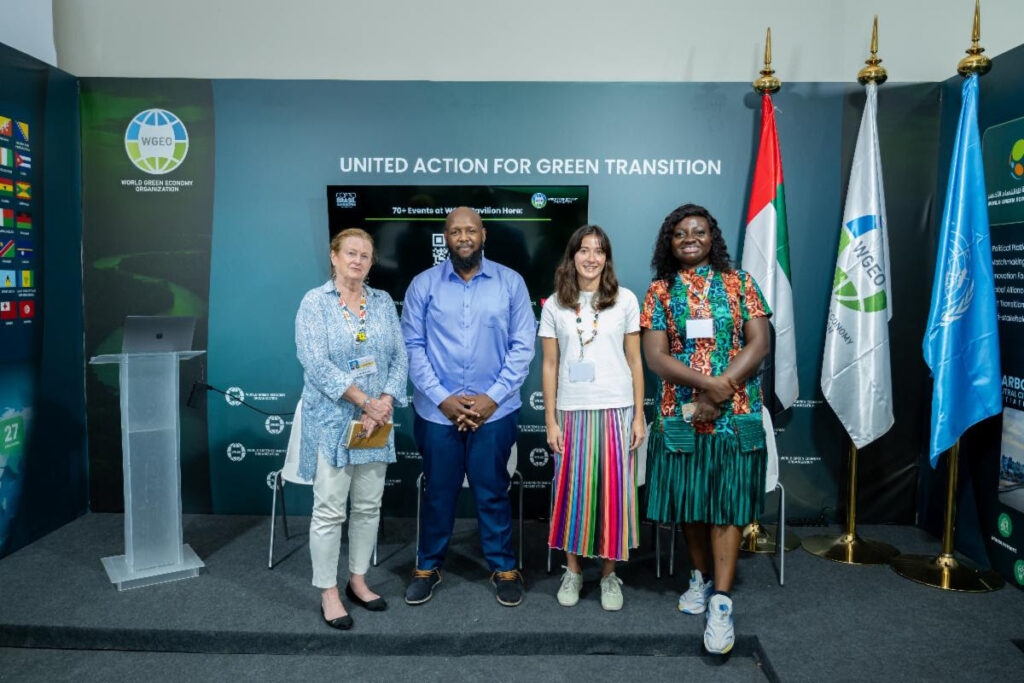
This session showed that strengthening food systems in a climate-stressed world requires closing the gender gaps that limit women’s participation across production, processing, and trade. Speakers emphasized that women are key drivers of climate-smart agriculture, yet continue to face barriers in accessing land, finance, technology, and markets.
Panelists highlighted that inclusive policies, gender-responsive business models, and targeted investments can significantly boost supply-chain resilience. Successful examples of women-led climate-smart enterprises show how empowering women enhances productivity, innovation, and community resilience.
The discussion also showcased the role of digital tools, tailored financial products, and public-private partnerships in scaling gender-equitable food systems. Stronger integration of gender in climate finance and global trade frameworks was identified as critical for long-term transformation.
Gender-Responsive Climate Finance: Designing Inclusive Investment Mechanisms

Women’s empowerment is not just a social good — it is a measurable driver of climate impact and financial returns. This WOCAN moderated session explored how outcomes-based finance is creating a new class of investable opportunities that generate verified benefits for women, communities, and the planet.
Speakers included Ana Maria Loboguerrero from the Gates Foundation, Shubhi Goyal from the Huairou Commission, and Sandeep Roy Choudhury from Value Network Ventures (VNV) joined the discussion, sharing insights on how gender-responsive financial mechanisms can accelerate climate adaptation and strengthen community resilience.
Panelists highlighted real-world projects linking gender outcomes with carbon co-benefits, demonstrating how tradable W+ credits and catalytic capital from both public and private actors can drive measurable social and climate impact. Together, their perspectives reinforced the growing recognition that gender-responsive climate finance is fundamental to achieving effective, scalable climate solutions.